
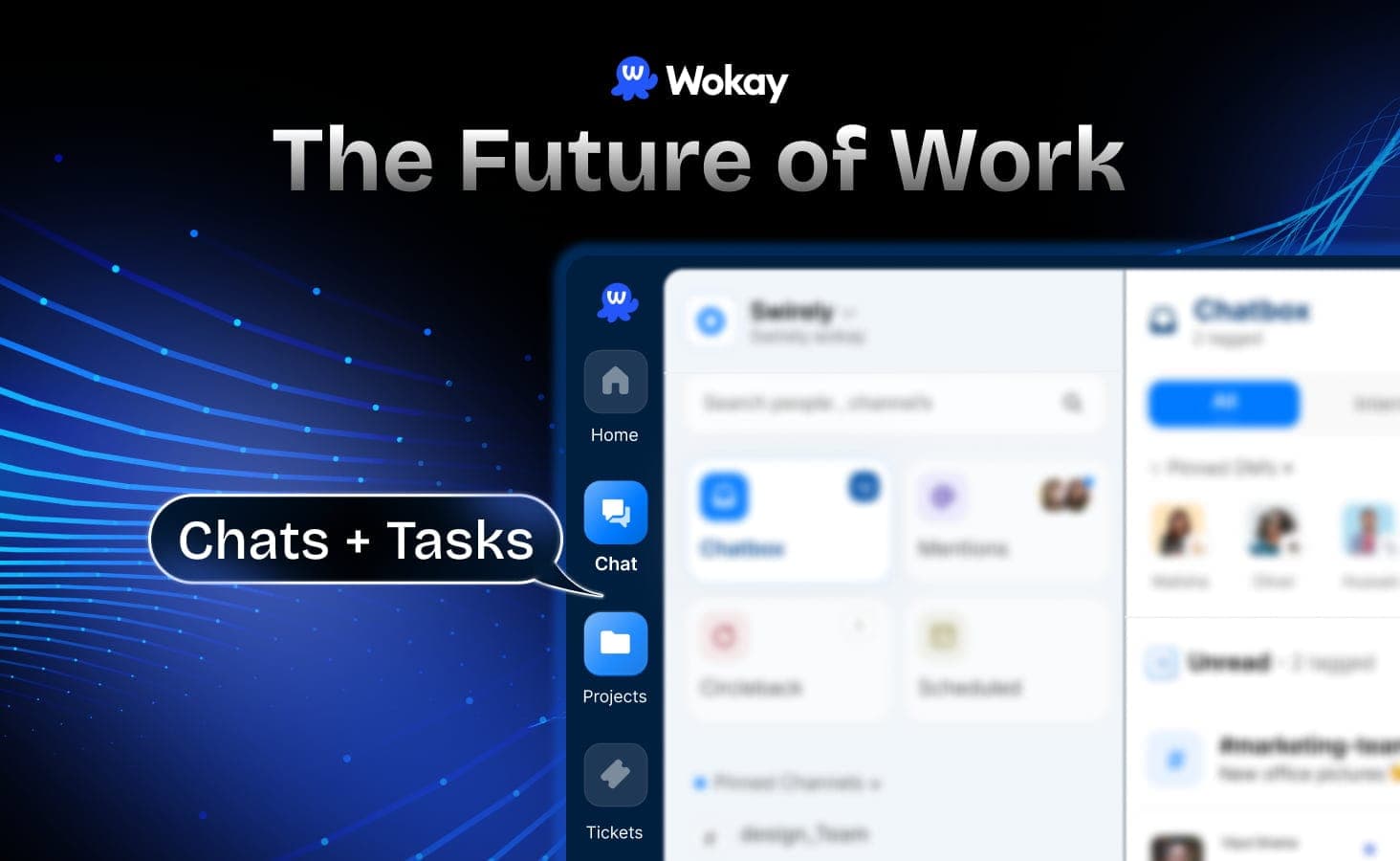
Chat + Task Management, Together: That's the Future!
Work Collaboration
Discover how AI-powered collaboration tools are reshaping teamwork and driving productivity. And watch the video to see it in action!

Wokay Team
Insights on startups, and small to medium businesses. From those who've seen it, felt it, fixed it!

Ever feel like you’re spending more time juggling apps than actually working? You’re not alone.
The average employee now switches between 13+ apps a day, with nearly 70% admitting this wastes up to an hour daily (Harvard Business Review). That’s five hours a week — almost a full workday lost to context switching, not real work.
McKinsey adds to this picture. Employees spend 20% of their week just searching for information or tracking colleagues for updates (CottrillResearch/McKinsey).
It doesn’t take long to see where things break down. When chats live in one app and tasks in another, updates slip, priorities blur, accountability fades — and subscription costs pile up. The gap between communication and execution is the real productivity killer.
That’s why pairing chat with task management isn’t just convenient: It’s the ultimate productivity combo.
Let’s break it down.
Chat is fast. It’s where ideas spark, approvals get shared, and decisions happen in real time.
But speed has a downside. As one Reddit user puts it: “Our Slack channels felt like group therapy sessions — lots of venting, lots of ideas, but zero follow‑through.”
This isn’t uncommon.
Research from the Journal of Applied Psychology shows that chat-only communication leads to higher information overload and poorer recall of decisions (BCPublication/Info Overload).
On the flip side, task managers like Asana, Jira, or Trello give much-needed structure but lack the immediacy of chat. It’s like keeping a pristine to-do list that no one remembers to update.
MIT’s Sloan Management Review notes that teams waste 25% of project time clarifying miscommunication between tools (MIT Sloan Management).
An anecdote from a startup CTO captures this: “We had Jira for tasks and Slack for discussions. By the time we updated Jira, the conversation had already moved on in Slack. Our devs simply gave up keeping both in sync.”
This is where Wokay.com rethinks collaboration. Teams don’t just need chat and tasks — they need the two seamlessly intertwined.
Think of it as the bridge between “talking about work” and “getting work done.”

Fig 1: Bringing chat and task management together transforms teamwork, saves time, and cuts costs.
The industry is slowly waking up to this integration — though often by patching tools together. Examples:
ClickUp added chat to reduce tool overload (reference).
Asana introduced “AI Teammates” to bridge work and conversations (reference).
Slack launched AI summaries to extract insights from chat (reference).
Wokay.com, however, wasn’t patched after the fact. It was designed from day one as a native fusion of chat + tasks, making it more seamless than “app stacks” that force teams to duct-tape workflows.
So, how do you use Wokay.com for best results?
Project spaces in Wokay keep chats and tasks tightly bound contextually.
Standardize chat-to-task conversion so nothing falls through.
Dashboards show conversations, progress, and priorities side-by-side, like a control tower for your team.
Automate decisions, summaries, and follow-ups with Wokay’s built-in AI (coming soon).
The future of productivity isn’t bouncing between a chat tool and a task app. It’s the fusion of communication and execution, powered by AI. Wokay delivers exactly that today — a unified solution to cut clutter, accelerate decisions, and ensure accountability.
But here’s the exciting part: this is just the start. Wokay is building toward a future where AI, meetings, projects, and document collaboration converge into one intelligent workspace. What you see today is powerful — but what’s coming next is set to revolutionize productivity for modern teams.
Discover how AI-powered collaboration tools are reshaping teamwork and driving productivity. And watch the video to see it in action!
Wokay Team

Teams now are seeking Slack and Asana alternatives that offer unified communication and task management. Learn more.
Wokay Team

In today’s fast-paced business world, teams need more than simple messaging apps like WhatsApp to stay productive and organized.
Wokay Team